Most homeowners find out they have mice or rats the same way: they spot a dropping in a kitchen drawer, hear something scratching at 2 a.m., or open a cabinet to find a bag of flour with a hole chewed through it. By that point, the infestation is rarely new. Rodents are cautious, mostly nocturnal, and very good at staying out of sight until they've already established a foothold in your walls.
The early signs — the ones that let you intervene before you're dealing with a colony — are subtler. This guide covers the seven indicators that experienced pest pros look for first, and what each one tells you about the size and seriousness of what you're dealing with.
Quick navigation
If you've already spotted something and want to act now, skip to the severity assessment at the bottom — it'll help you decide whether this is a DIY situation or a call-the-exterminator moment.
Why early detection matters more than most people think
A single female mouse can produce 5 to 10 litters per year, with 5 to 6 pups each. A pair of mice that moves into your home in October can become a problem of 20 to 30 animals before spring. Rats reproduce more slowly but cause structural damage and contamination at a scale that mice rarely match. In both cases, the window between "a mouse got in" and "we have a serious infestation" is measured in weeks, not months.
Catching the signs early doesn't just save money on treatment — it limits the gnaw damage to wiring and insulation, the contamination of food and surfaces, and the secondary pest issues (fleas, mites) that rodents often carry in with them.
The 7 signs to look for
1. Droppings — but pay attention to size and location
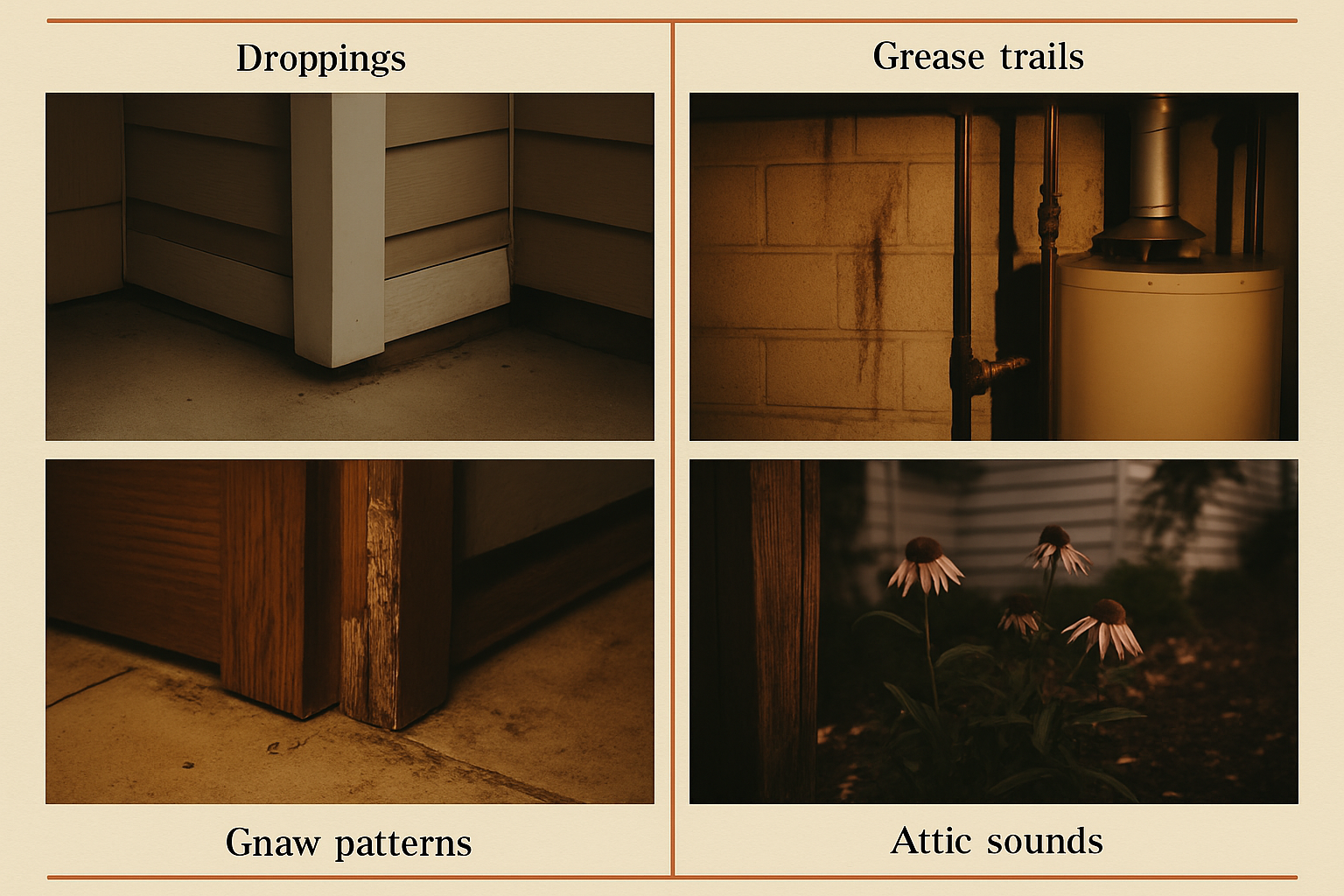
Yes, droppings are the obvious one. But most homeowners look for them in the wrong places and misread what they find. Fresh mouse droppings are dark, moist, and roughly the size of a grain of rice. Rat droppings are larger — about the size of a raisin — with blunt ends. Old droppings are dry, grey, and crumble easily. If you're finding fresh droppings daily, activity is ongoing. If they're all old, you may be looking at a resolved or seasonal issue. Check along baseboards, inside cabinet corners, and behind appliances first.
2. Grease trails and rub marks
This is the sign most homeowners walk past for months without recognizing it. Rodents — particularly rats — follow the same travel routes repeatedly and leave oily smears from the sebum in their fur along walls, pipes, and beams. These rub marks are dark grey or brownish, roughly the width of a finger, and appear at the height the animal travels. Finding fresh, dark rub marks tells you not just that something is present, but that a specific route is in regular use — which is exactly where you want to place a trap or bait station.
3. Gnaw marks on unexpected materials
Food packaging and baseboards are the expected targets. What surprises homeowners is the range of materials rodents will chew through: electrical wiring insulation, PEX plumbing tubing, HVAC duct foil, and even concrete block mortar. Fresh gnaw marks are pale and clean-edged. Older marks are darker and weathered. If you find gnaw damage on wiring, treat it as urgent — it's a fire hazard, not just a pest problem.
4. Nesting material in unusual places
Mice shred soft material to build nests — insulation, paper, fabric, cardboard, dried plant matter. You'll find nests tucked into seldom-opened drawers, behind insulation batts in the attic or crawl space, inside stored boxes, and inside the insulation cavity of large appliances. A nest with juveniles present means the infestation is well established and actively reproducing. A nest with no animals but fresh shredding nearby means they've recently relocated — possibly because something disturbed them.
5. Sounds at specific times
Scratching, rustling, and scurrying in walls or ceilings is common knowledge. What most homeowners don't know is that the timing matters. Mice are most active just after dusk and just before dawn. Rats tend to be louder and more varied in their activity hours. If you hear sounds consistently in the same wall section, note the time — and note whether the sounds move, which tells you whether you're hearing travel or nesting activity. Isolated sounds from a single spot in an attic or wall cavity often indicate a nest site.
6. Tracks and runways in dust or insulation
In attics, crawl spaces, or along basement ledges where dust accumulates, rodent footprints and tail drag marks are often clearly visible. Mouse footprints are small and delicate with a narrow straddle; rat prints are larger with a wider stance. If you suspect activity in an attic but aren't sure, lay a piece of cardboard lightly dusted with flour or talc overnight — any tracks the next morning confirm presence and often reveal the species.
7. Pet behavior changes
Dogs and cats frequently detect rodents well before their owners do. A dog suddenly fixating on a stretch of baseboard, a cabinet, or a specific wall section — especially combined with any of the other signs above — is worth investigating. Cats may crouch and watch a refrigerator gap or pantry corner for extended periods. This isn't conclusive on its own, but paired with even one other sign, it's a reasonable prompt to do a more thorough inspection.
Expert note from Darnell Whitfield, ACE
"When I'm doing an initial inspection, I always check the grease trails first — they're the most honest signal about how frequently a route is being traveled. A single dropping could be an isolated animal passing through. Rub marks on a pipe run mean that route is being used every night, and that's where your trap goes. Most homeowners have never heard of rub marks until I show them one that's been on their wall for six months."
Assessing severity: DIY or call a professional?
Use these four questions to gauge where you stand:
- Are you finding fresh droppings in multiple rooms, or just one area? Multiple rooms suggest an established population moving freely through the structure. Single-area activity is more likely containable with traps.
- Have you found a nest with live or dead juveniles? If yes, the population is actively reproducing and a trap-only approach will lag behind the birth rate. Bait stations and exclusion work should be part of the plan.
- Is there gnaw damage to wiring or plumbing? If yes, call a professional — the structural risk elevates this beyond a simple pest problem.
- Have standard snap traps or electronic traps been active for two weeks with no reduction in sign? A persistent infestation despite active trapping usually means the entry points haven't been found and sealed. An exclusion inspection is the next step.
The bottom line
You don't need to see a live rodent to confirm you have a problem — and by the time you do, the problem is usually a month old at minimum. The combination of fresh droppings, rub marks, and gnaw activity in the same area is about as reliable a confirmation as you'll get without setting a trap. Start your inspection in the kitchen, utility room, and attic; those are the three most common establishment zones in residential structures.
If you're ready to start trapping, our Best Mouse Traps for Home Use review walks through snap, electronic, and live-catch options tested for trigger sensitivity and reset speed — so you're not guessing at the hardware store.
Ready to start trapping?
See our editor-tested ranking of the best mouse traps for home use, including snap, electronic, and live-catch options.
Read the Comparison→